Published: Apr 24, 2026
Poor

Full
$325
35-year-old, sedan, full coverage
Liability
$188
per month
Cheaper than
2%
of states
Florida | Auto Insurance Affordability
Poor
Florida insurance rates are significantly above average, ranking 49th in the nation. Only 2% of states offer pricier options.
Avg. Full Coverage
$325/mo
35-year-old, sedan, full coverage
Avg. Liability Only
$188/mo
State minimum
Cheaper Than
2%
of US states
What You Need to Know
- Florida drivers pay an average of $2,254 annually for minimum-coverage policies, while full coverage runs $3,800 to $4,100 per year, placing the state among the three most expensive in the nation according to the Insurance Information Institute.
- Rates swing dramatically by city: Orlando averages roughly $3,725 per year for full coverage while Miami and Fort Lauderdale push past $4,600, a gap wide enough to matter when you're shopping.
- Florida accounts for 394,845 quote requests in the SaveMaxAuto database, 11.7% of the entire national dataset, the single largest state volume in our system.
- Before your next renewal, pull quotes from at least four carriers using the Save Max rate comparison tool, the spread between carriers in Florida is wide enough that staying put is actively costing you money.
Rate Snapshot
*Primary premium data sourced from Experian, March 2026 and the Insurance Information Institute.*
Florida is in a category by itself when it comes to auto insurance pricing. Georgia next door runs roughly $1,000 to $1,700 less per year for full coverage. That gap doesn't happen by accident. Three structural forces drive it: the no-fault insurance system, an uninsured driver population that rivals any state in the country, and a hurricane exposure that makes comprehensive coverage genuinely expensive rather than just bureaucratically inflated. Let's unpack each one.
Florida's No-Fault Law: The Hidden Engine Driving Premiums Up
Every Florida driver is legally required to carry Personal Injury Protection (PIP), a minimum of $10,000, plus $10,000 in Property Damage Liability. That's it. No bodily injury liability required at the state minimum level. Florida is one of the few states in the country that still operates under a true no-fault framework, meaning your own insurance pays for your injuries regardless of who caused the crash.
That sounds fine in theory. In practice, it created one of the most aggressively exploited claims environments in the nation.
PIP fraud has been a documented problem in Florida for decades. Staged accidents, inflated medical billing, and attorney referral networks feeding off ten-thousand-dollar PIP payouts became so common that the Florida Justice Reform Institute and multiple legislative sessions have addressed the issue directly. Carriers priced the fraud risk into every policy across the state, not just the ZIP codes where fraud was concentrated. You paid for fraud even if you drove in rural Alachua County and never filed a single claim.
Here's what that actually looks like in numbers:
- Florida's average auto insurance expenditure in 2022 was $1,625 per year, the highest in the nation, according to the Insurance Information Institute.
- The national combined average premium was $1,438 per vehicle in 2023 according to the NAIC Auto Insurance Database Report.
- Florida minimum coverage alone averages $2,254 annually, which is roughly 3.5 times the national minimum-liability average.
That last number is brutal, honestly. Minimum coverage in Florida costs more than full coverage in many other states. The no-fault structure doesn't cap costs. It creates an incentive structure that keeps them high.
Why 2026 Is Actually Different, Rates Are Finally Coming Down
Something changed.
Florida's top five auto insurers reduced premiums by an average of 8% for 2026, affecting nearly 80% of policyholders, according to the Tallahassee Democrat. USAA filed a separate average 7% rate decrease effective by May 2026, saving policyholders more than $125 million annually per the Florida Office of Insurance Regulation.
This isn't a coincidence. Florida passed a wave of tort reform and insurance market reforms starting in 2022 and 2023. The legislature eliminated one-way attorney fees that had previously made Florida a playground for lawsuit abuse. Carriers that had been losing money or exiting the market started filing rate reductions. The pricing environment in Florida is genuinely improving for the first time in years.
*Editor's note: This doesn't mean Florida is suddenly cheap. An 8% reduction on a $4,500 policy is still a $4,140 policy. The state remains expensive. But the direction has reversed, and if you haven't shopped rates since mid-2024, you may be paying more than your renewal actually requires.*
The catch? Not all carriers passed savings along at the same rate. Progressive customers in Florida may already see a credit on their statements, per reporting from Greene Insurance and corroborated by YouTube coverage of the 2026 rate changes. Other carriers moved slower. Which is exactly why shopping multiple quotes matters more now, not less.
The Uninsured Driver Problem Florida Doesn't Talk About Enough
One in five.
That's roughly how many Florida drivers on the road right now carry zero insurance, according to the Mickey Keenan law firm's analysis of Florida DHSMV data and the Florida Justice Reform Institute. The Florida Highway Safety and Motor Vehicles agency tracks registered vehicles with no coverage, and the numbers are not flattering.
At the national level, 15.4% of drivers were uninsured in 2023, per the Insurance Research Council. Florida's rate runs higher than that by most estimates. One Reddit thread in r/Insurance titled "Florida Uninsured Motorist 10x increase in <2 years" put it bluntly: "One out of every six drivers in Florida carries NO insurance, and who knows how many have no BI liability coverage at all."
So what does this mean for your premium? A lot. When carriers calculate risk in Florida, they're pricing for the strong probability that the person who hits you either has no insurance or has the bare state minimum with no bodily injury coverage. That forces every insured driver to carry more coverage than they otherwise would need, and to pay for it. Uninsured motorist coverage in Florida runs approximately $200 to $400 annually extra according to Harbour Insurance, but experts and Reddit regulars alike recommend carrying it.
"First, make sure you have UM (uninsured motorist) insurance of at least $100,000. Florida does not require BI insurance, meaning there are a lot of drivers out there with no coverage if they hit you.", r/Orlando, insurance thread
The advice on r/Insurance threads is consistent: carry at least 100k/300k/100k, ideally 250k/500k/250k, because the person who rear-ends you on I-95 statistically has a one-in-five chance of carrying nothing.
City Cost Breakdown
Florida is not a monolith. The difference between insuring a car in Tallahassee and insuring the same car in Miami is not a rounding error.
*City figures sourced from SoFi, MarketWatch Orlando data, and MarketWatch Miami data.*
The Tampa-Miami corridor dominates the expensive end of this list for structural reasons, not just population size. Tampa has a documented crash frequency problem compounded by a dense uninsured driver population in certain ZIP codes. Miami sits at the intersection of high PIP fraud history, extreme traffic density, and genuine theft exposure in pockets of the metro.
Orlando lands in the middle of the pack by Florida standards, which sounds reassuring until you remember that "mid-range" in Florida still means $3,725 per year. The MarketWatch data shows Orlando minimum coverage at $1,737 annually, 136% more than the national average for minimum coverage. Mid-range in Florida is expensive by any other state's definition.
Coastal cities carry an additional layer that inland drivers don't always account for: comprehensive pricing inflated by hurricane exposure. A car sitting in a Fort Lauderdale driveway during hurricane season is a materially different risk than one in Gainesville.
Carriers price that in. Comprehensive coverage in coastal ZIP codes can run 30% to 50% higher than equivalent inland coverage, and it's not always broken out clearly on your quote sheet.
Vehicle Cost Variation in Florida
The state's environmental and legal conditions affect different vehicle categories in very different ways.
*Ranges are Florida-adjusted estimates based on national EV premium data from Recharged and general vehicle premium research.*
EVs deserve a separate conversation in Florida specifically. The state's heat and humidity create battery degradation conditions that don't exist in Colorado or Minnesota. More critically, Florida's coastal exposure means a car that floods in a storm is a total loss, and a flooded EV with a compromised battery pack is not a simple claim. Carriers know this. EV premiums in Florida run toward the high end of national EV pricing even when you control for driver profile.
Pickup trucks in Florida are interesting because of comprehensive exposure. In hail-prone inland areas, parts of Central Florida get severe weather regularly, large-surface vehicles like trucks and full-size SUVs accumulate higher comprehensive claims than smaller cars. The roof and hood exposure is just bigger. Tampa area owners of full-size trucks have reported comprehensive deductibles eating into savings that they'd assumed came from driving a practical vehicle. If you're deciding between a truck and a sedan in Florida, add comprehensive cost to your math.
Driver Profile Variables
The same 2024 Honda CR-V in the same Orlando ZIP code can cost $2,400 or $4,800 per year. Driver profile is why.
Credit scoring is fully legal in Florida and carriers use it aggressively. A driver with poor credit can see rates approach those of a driver with a recent at-fault accident, even with a spotless driving record. That's not a quirk. Florida carriers lean heavily on credit as a proxy for overall risk behavior, more so than many other states. If your credit has improved in the past two years, get new quotes. Don't assume your insurer repriced you favorably.
Age hits harder at the young end in Florida than in some other states, partly because young Florida drivers are statistically overrepresented in the crash data that carriers pull from the Florida DHSMV. A 25-year-old male in a coastal metro looking at full coverage is not going to have a pleasant experience shopping. One Reddit user asked directly: "When can I expect to pay less than $800/mo?" The thread responses were not optimistic.
"FL is one of the worst states in the nation right now for insurance. The rate you are seeing sounds quite reasonable, but you're welcome to shop around.", r/Insurance
Coastal Versus Inland: The Hurricane Premium Nobody Explains
Pay attention to this part.
Most Florida insurance articles talk about hurricanes in the homeowner's insurance context. The auto side gets ignored. But comprehensive auto coverage, which covers storm damage, flooding, and falling debris, is a real line item on your premium that varies enormously by proximity to the coast.
A car insured in Naples or Sarasota sits in a verified hurricane impact zone. A car insured in Ocala or Gainesville faces legitimate storm risk, but not the same sustained coastal flooding and surge exposure. Carriers have actuarial data on this by ZIP code. Your comprehensive rate reflects where you park your car at night, not just where you drive.
Drivers in coastal markets who finance their vehicles are often required by their lender to carry comprehensive. That requirement becomes expensive when the comprehensive rate is inflated by storm modeling.
Some inland drivers elect to drop comprehensive on older vehicles precisely because the premium stops making financial sense. That calculation changes completely if you're two miles from the Gulf Coast.
- Coastal ZIP codes in South Florida (33xxx, 34xxx ranges) carry higher comprehensive pricing than inland equivalents.
- Hurricane-season surges in comprehensive claims cause carriers to adjust forward-looking rates.
- Gap insurance becomes relevant in total-loss flood scenarios, particularly for financed vehicles in storm corridors. The Save Max guide to gap insurance costs covers this in detail.
- Comprehensive deductibles in Florida commonly run $500 to $2,500, choosing the right deductible in a coastal ZIP code is not a casual decision.
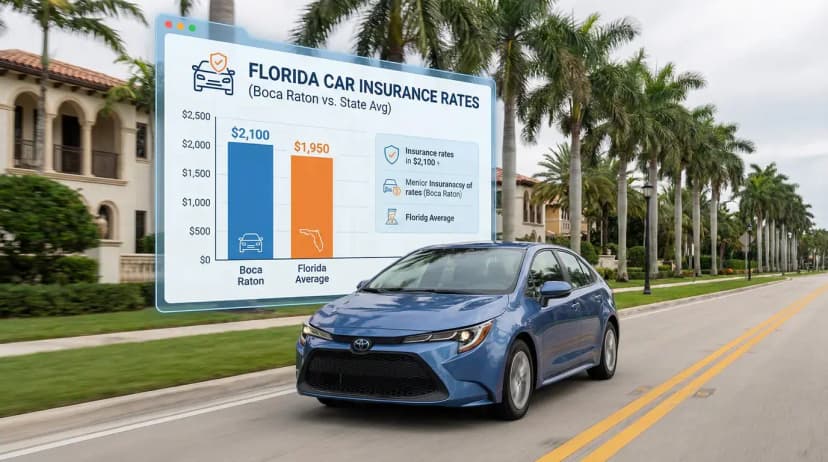
This is a genuinely local pricing dynamic that statewide average figures hide completely. If you're comparing your premium to a friend in Orlando while you live in Boca Raton, you're comparing against the wrong benchmark.
Florida-Specific Discounts Most Articles Never Mention
Expensive market. Fine. But Florida also has discount mechanisms that most coverage articles skip over.
- Safe driver programs: Progressive's Snapshot and State Farm's Drive Safe & Save operate in Florida. Consistent safe driving behavior tracked via telematics can cut premiums 10-30% for low-mileage or smooth-driving profiles.
- Military rate reductions: USAA's 2026 rate filing explicitly identified military service members as a beneficiary category. Active duty and veterans shopping in Florida should compare USAA directly against their current carrier.
- Bundling with renters insurance: Florida homeowner's insurance is its own crisis, but renters insurance is cheap, and bundling with auto can produce 5-15% savings on the auto policy.
- Good student discount: Applies through age 25 in most carrier programs, relevant for the young-driver premium problem above.
- Defensive driving course credit: Florida-approved courses reduce the insurance surcharge from a ticket in some cases, and some carriers credit the course even without a violation on record.
- Low-mileage programs: Pay-per-mile insurance is worth evaluating for remote workers or retirees who drive under 8,000 miles annually. Is pay-per-mile insurance worth it?, that question has a different answer in Florida than in commuter-heavy states.
None of these discounts appear automatically. You have to ask. Carriers don't volunteer savings they're not required to offer.
How to Actually Shop This Market
One more thing.
Florida's rate spread between carriers is wide. Genuinely wide. A driver with an identical profile gets meaningfully different quotes from Progressive, GEICO, State Farm, Travelers, and Allstate. Travelers reportedly offers competitive full-coverage rates in Florida according to U.S. News data, while GEICO and Progressive remain the most commonly cited carriers in Florida Reddit threads for accessible pricing. But none of that matters if you don't get quotes from all of them.
The SaveMaxAuto database, which covers 394,845 Florida quote requests, the largest single-state volume in our system, reflects this spread. Drivers coming to us from Florida arrive with policies from nearly every major carrier. The full methodology is at our trust record page. What the volume tells us is that Florida drivers shop actively, and the spread in the market is exactly why.
For practical steps:
- Use the Save Max car insurance calculator to establish a coverage baseline before you call carriers.
- Get quotes from at least four carriers. In Florida, three isn't enough.
- Check whether your current carrier passed along 2026 rate reductions. If your renewal went up or stayed flat, they may not have.
- Review your UM/UIM coverage limits. Given Florida's uninsured motorist rate, inadequate UM coverage is an active financial risk.
- Look at your comprehensive deductible relative to where you park. Coastal drivers with low deductibles may be over-insuring on a vehicle that would be a total loss in a major storm anyway.
The best car insurance companies list is a reasonable starting point, but in Florida specifically, what's "best" varies significantly by your profile, ZIP code, and vehicle type.
*Editor's note: We looked at a significant number of Florida-specific Reddit threads and insurance forum posts while researching this article. The consistent theme across drivers of every profile: the gap between the most expensive and least expensive quote for an identical situation was regularly 40-60%. That's not small. That's a car payment or two every month, depending on the profile.*
FAQ
Why is Florida car insurance so expensive compared to other states?
Three structural factors stack on top of each other: the no-fault PIP system created decades of fraud-driven claim inflation; the uninsured motorist rate approaches one-in-five drivers, forcing insured drivers to effectively subsidize that risk; and coastal hurricane exposure inflates comprehensive coverage pricing in ways that don't apply in landlocked states. Florida ranked as the most expensive state for average auto insurance expenditure in 2022 according to the Insurance Information Institute, and while 2026 reforms are helping, the structural cost floor remains elevated.
Are Florida auto insurance rates actually coming down in 2026?
Yes, but moderately. The top five auto insurers in the state averaged an 8% rate reduction for 2026, affecting roughly 80% of policyholders. USAA filed separately for a 7% average decrease effective by May 2026. These follow tort reform and one-way attorney fee elimination passed in the 2022-2023 legislative sessions that made the market less hostile to carriers. An 8% cut on a $4,000 policy is still a $3,680 policy. Meaningful improvement, but not a dramatic restructuring.
Does Florida require bodily injury liability insurance?
No. Florida only requires $10,000 in Personal Injury Protection (PIP) and $10,000 in Property Damage Liability at the state minimum. Bodily injury liability is optional under Florida law, which is unusual nationally and contributes to why being hit by an uninsured or minimally insured driver in Florida can leave you with no path to compensation from the at-fault party. Experts consistently recommend carrying bodily injury coverage anyway, along with substantial uninsured/underinsured motorist limits.
What coverage limits should I actually carry in Florida?
The Reddit consensus, supported by insurance professionals in Florida-specific threads, is a minimum of 100k/300k/100k for liability plus matching uninsured/underinsured motorist coverage. The recommendation for drivers with assets to protect runs to 250k/500k/250k. Given that Florida doesn't require BI liability and that roughly one in five drivers is uninsured, your UM/UIM coverage is often the only thing standing between you and out-of-pocket medical costs after a crash caused by someone else.
How much does uninsured motorist coverage cost in Florida?
Approximately $200 to $400 annually for a typical policy, according to Harbour Insurance's 2026 data. Given Florida's uninsured driver rate, that is an extremely cost-effective addition to any policy. Stacked UM/UIM coverage, which multiplies your coverage across each vehicle on the policy, costs more but provides significantly better protection and is worth pricing out.
Why does car insurance cost so much more in Miami than in Orlando?
Miami carries a combination of factors that compound: historically high PIP fraud activity, extreme traffic density, higher vehicle theft rates in certain urban ZIP codes, and proximity to the coast. Orlando's rate is lower but still above the national average for the same structural reasons at reduced intensity. The gap between the two cities runs roughly $900 to $1,000 annually for full coverage on the same vehicle.
Can I lower my Florida premium without dropping coverage?
Yes. Telematics programs through Progressive or State Farm reward safe driving with meaningful discounts. Bundling with renters insurance produces savings at most carriers. Completing a Florida-approved defensive driving course can credit your premium even without a violation on record. If your credit score has improved in the past two years, getting fresh quotes is essential because carriers reprice at renewal using updated credit data, but some don't notify you that a credit improvement would qualify you for a lower tier.
Sources
1. Insurance Information Institute, Auto Insurance Expenditure by State
2. Insurance Information Institute, Uninsured Motorists Facts and Statistics
3. NAIC, 2022/2023 Auto Insurance Database Report
4. Insurance Research Council, Uninsured Motorist Rate Data
5. Experian, Average Cost of Car Insurance in Florida, March 2026
6. Tallahassee Democrat, Florida Auto Insurance Rates Dropping in 2026
7. Florida Office of Insurance Regulation, Commissioner Approves Rate Cuts 2026
8. Mickey Keenan, P.A., 20 Percent of Florida Drivers Are Uninsured
9. Florida Justice Reform Institute, Uninsured Drivers Adding to Insurance Costs
10. Florida Highway Safety and Motor Vehicles, Uninsured Motorist Rate
11. Reddit r/Insurance, Florida Uninsured Motorist 10x Increase
12. Reddit r/Orlando, Car Insurance Recommendations
13. Reddit r/Insurance, WOW Car Insurance in Florida Is Out of Control
14. Reddit r/Insurance, 25M Florida When Can I Expect to Pay Less Than $800/mo
15. MarketWatch, Car Insurance Miami
16. MarketWatch, Car Insurance Orlando
17. SoFi, Average Cost of Car Insurance in Florida by City
18. Harbour Insurance, How Much Is Car Insurance in Florida 2026
19. Recharged, Electric Car Insurance Cost by Model